
Quick answer
Are aerial trams safe? Modern aerial trams are among the safest forms of guided transport, with accident rates consistently lower than road travel. At Rainforest Adventures Jacó, cabins are built to international cable transport standards, inspected daily, and operated by certified technicians. The system includes automatic braking, redundant cable anchors, and weather monitoring that halts operations when wind or lightning conditions exceed safe thresholds.
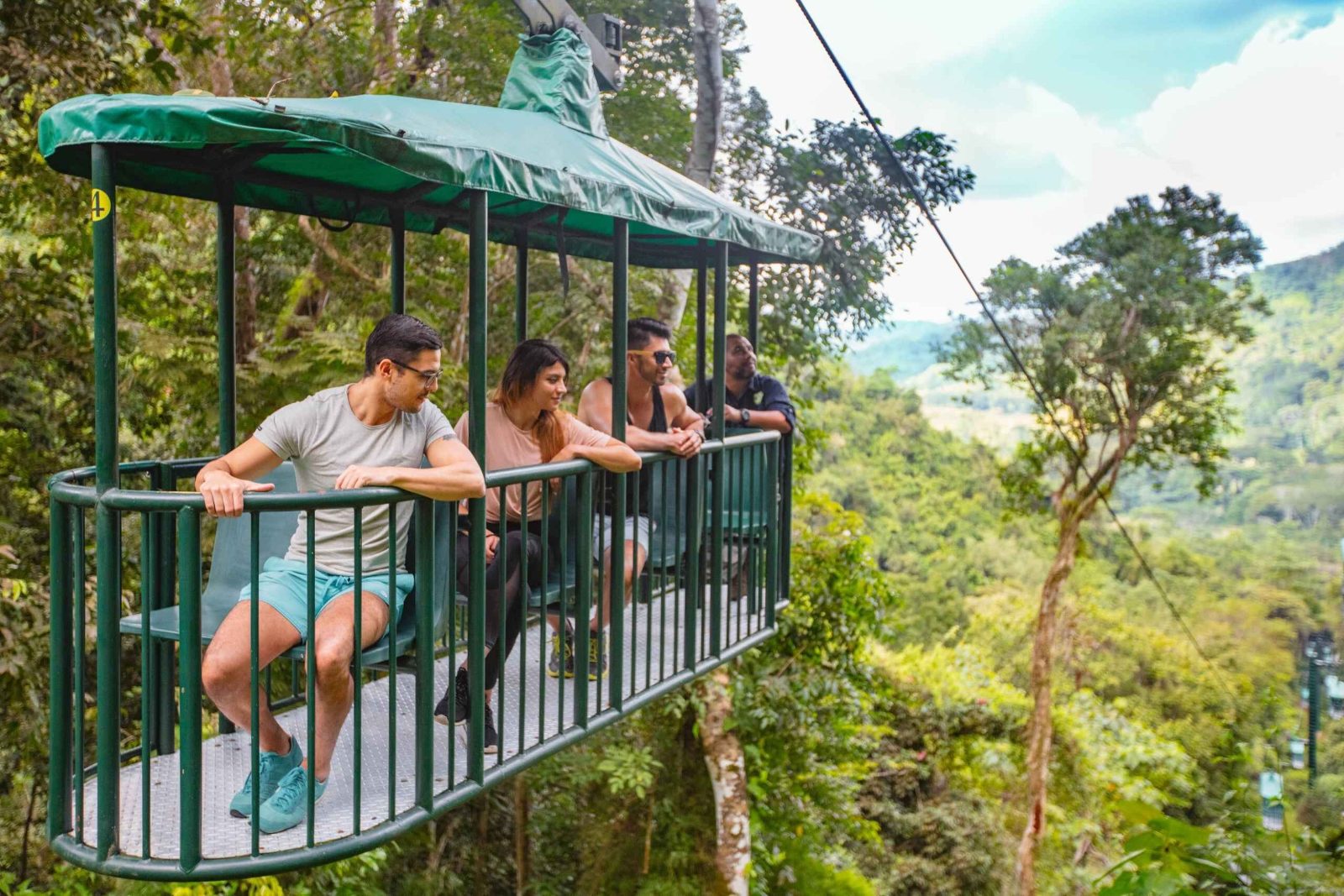
Every aerial tram cabin at Rainforest Adventures Jacó is rated to carry twelve passengers plus an operator, with a safety margin four times the maximum load. The cable itself is a braided steel assembly designed to withstand forces far beyond normal operating stress, inspected with ultrasonic sensors that detect internal wire fatigue before it becomes visible. Cabin construction follows the same principles used in Alpine gondola systems: welded steel frames, tempered glass panels, and roof-mounted emergency hatches. Doors lock automatically during transit and cannot be opened until the cabin reaches a station platform. Each cabin hangs from a detachable grip mechanism that clamps onto the haul cable; at stations, the grip releases and the cabin slows on a separate rail, allowing passengers to board without stopping the main cable loop. The question of aerial tram safety often centers on weather. Operations pause when sustained winds exceed 50 kilometers per hour, a threshold programmed into the control system. Lightning within ten kilometers triggers an automatic shutdown. Daily inspections check cabin integrity, cable tension, and tower bearing lubrication before the first departure at 08:00. Monthly maintenance includes full cable examinations and load testing of backup systems. Rainforest tram operators complete a three-week certification covering emergency descent procedures, passenger communication, and mechanical diagnostics. Each operator carries a two-way radio linked to the control station, where technicians monitor cable speed, tower load sensors, and cabin spacing in real time. If a cabin stops mid-route, evacuation protocol uses a secondary cable and harness system to lower passengers to the forest floor, a procedure practiced quarterly. The technology is not experimental. Aerial ropeways have moved people across mountainous and forested terrain since the early twentieth century, evolving from ore-transport systems into precision passenger carriers. Modern installations in Costa Rica, Switzerland, and Singapore share core design elements: redundant cables, gravity-assisted braking, and cabins engineered to remain stable even if a single support component fails. The result is a transport mode with a safety record that exceeds buses, ferries, and most recreational activities. Visitors concerned about enclosed spaces or heights should know that cabins remain open-air at the sides, with mesh panels allowing continuous airflow. The ride itself is smooth, with minimal swaying except during station approach. Motion sickness is rare. The operational focus is on predictability rather than thrill, a deliberate engineering choice that prioritizes reliability over speed.
“Modern aerial trams carry a safety record that exceeds road transport, built on redundant systems and daily inspection protocols.”
Are Aerial Trams Safe? Engineering and Safety Standards
Aerial tram operations in Jacó adhere to rigorous engineering protocols designed to ensure passenger security throughout the transit process. Systems are built with multi-layered redundancies and undergo routine technical evaluations.
Mechanical redundancy
The aerial tram system utilizes dual-cable support structures and independent braking mechanisms to ensure continued stability and control during operation.
Regular load testing
Operators conduct systematic weight-bearing assessments to verify that all hardware maintains structural integrity well within rated load capacities.
Daily inspection protocols
Maintenance teams perform mandatory pre-operation checks on all gondola attachments, grip mechanisms, and electrical systems before welcoming visitors each day.
Certified safety standards
The infrastructure is engineered to comply with international ropeway safety standards, which dictate specific requirements for equipment manufacturing and maintenance cycles.
Trained personnel monitoring
Every transit is overseen by technicians trained in emergency evacuation procedures and real-time system monitoring to manage operations effectively.
Weather-dependent operation
Tram movement is monitored against meteorological data, with automated systems in place to reduce speed or pause operations if wind speeds exceed pre-defined safety thresholds.
When Are Aerial Trams Safe to Operate in Jacó?
The best arrival window is 08:00–10:00, as wildlife is most active and temperatures are cooler in the morning. Operations prioritize safety, meaning trams may pause during high winds or severe rain to ensure passenger security.
Weekday mornings
Minimal congestion—
Lower visitor volume allows for a quieter experience with maximum wildlife visibility.
Dry Season (Dec–April)
High trafficSunny with temperatures 25°C to 30°C
Expect consistent operation, though early arrival is recommended to avoid peak heat and humidity.
Green Season (May–Nov)
Moderate trafficRain showers common, 22°C to 28°C
Afternoon rains are frequent; morning visits provide the most reliable operational conditions before clouds accumulate.
Verdict: For optimal safety, visibility, and wildlife activity, plan your visit for the 08:00–10:00 arrival window during the early months of the year.
Daily Operational Hours for Aerial Trams
The aerial tram at Rainforest Adventures Jacó operates on a consistent daily schedule throughout the week.
| Monday | 08:00–16:00 | |
|---|---|---|
| Tuesday | 08:00–16:00 | |
| Wednesday | 08:00–16:00 | |
| Thursday | 08:00–16:00 | |
| Friday | 08:00–16:00 | |
| Saturday | 08:00–16:00 | |
| Sunday | 08:00–16:00 |
How to Safely Arrive at the Aerial Tram Site
The Rainforest Adventures Jacó facility is located 3.5km east of Maxi Pali. The most straightforward approach is by vehicle via the main access roads leading from the Jacó town center.
Follow signs 3.5km east from Maxi Pali toward the mountain base
Request transport from Jacó center to the Rainforest Adventures entrance
Not recommended due to distance and terrain
Check availability
Frequently Asked Questions About Aerial Tram Safety
Everything you need to know about are aerial trams safe